

The Personal Growth of Hironobu Sakaguchi
I wanted to save discussing the most recently released JRPG in America for last. It’s one we all hold dear. Mere days before XSEED released The Last Story into the wild, I saw the credits roll for Final Fantasy IX, some twelve years too late. I’d played the game back in 2000, of course, but a rather mean disc-freeze dreadfully close to the end of the third disc prevented me from ever finishing it. I put it off, but our Top 10 PSOne Games list inspired me to grab this classic from PSN. And I’m truly glad I did. As it turns out, FFIX is virtually the perfect precursor to the game many of us experienced for the first time this past week.

Both games offer plenty of clichés (like the typical princess in disguise / “caged canary” character), and many reviewers would see these types of things as deterrents. I’m cut from a different cloth than the folks from Destructoid or Game Informer, however. I think if you take a bunch of clichés and wrap them inside a game that truly brings its characters and environments to life, these archetypal roles can break free from the chains of commonality.
Final Fantasy IX accomplishes this through the masterful artwork of Yoshitaka Amano. The storyline has its moments (especially as you get near the end) and Uematsu delivers as usual, but I don’t think this game would have the gusto it does if any other person designed it. Even clichéd characters and events can be given new life through powerful presentation. I consider FFIX to be “the last great Final Fantasy” because despite its handful of clichés and flaws, it offered much of what made JRPGs of its time great, as well as attempting to evolve conventional formulas (the Ability System comes to mind).
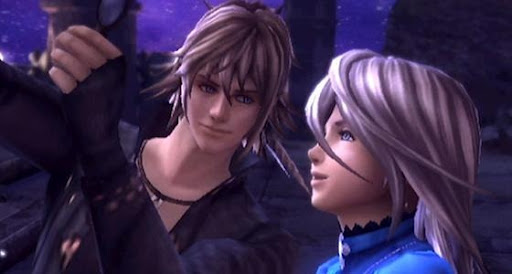
The Last Story accomplishes the same through the conversations that take place as characters move through the world. As much as Sakaguchi’s latest work doesn’t offer a particularly ground-breaking, life-changing story, its cast is given new life because of how they interact with the player as s/he explores the world. I consider Sakaguchi’s latest game another stepping stone in the continued evolution of the genre I love, but The Last Story doesn’t feel as personal to me because of the very things that make it unique. It’s not my story, after all…it’s Zael’s.

The End of an Era
I don’t necessarily wish I could go back to the way things were. Games like Radiant Historia and Xenoblade Chronicles have proven to me that not all good ideas are gone, and that growth is truly healthy for the games I love. What I do wish, however, is that a larger number of my peers could learn to embrace the past in order to realize what makes games like Xenoblade Chronicles, The Last Story, and Pandora’s Tower truly magical.
I know, to a certain extent, most RPGs cannot be “my personal journey” anymore. But you can all consider this my personal testimony: every RPG I’ve played through in the past contains a piece of who I am. The greatest RPGs offer a sense of personal growth to correlate with character growth.
I know things aren’t what they used to be. But as long as Operation Rainfall continues to support games, developers, and publishers that both know their roots and aren’t afraid to be inventive—I may yet be satisfied with what’s to come.


/Stands and claps
You have all my respect! I am also an old soul at the age of 27 and I feel exactly the same way you do. When my friends insisted I was weird for liking FFVI, FFVII and even FFVIII and not caring about FFX and beyond all I can say was “Sorry, it just doesn’t feel the same”. I am stuck in the past, leaving my heart for Zelda games and RPGs released on handhelds. The old RPGs are what impacted me most and inspired me. I don’t own a Wii, but I am seriously hoping Xenoblade Chronicles and The Last Story can have an impact on me where all new gen RPGs have left me feeling empty. I will be getting a Wii U and that is when I will play them.
I’ve not completely finished The Last Story, so I’m withholding judgement on the game for now. However, Xenoblade Chronicles is nothing short of a work of art that meets (if not surpasses) even the most nostalgia-tinted gamer’s (read: me, possibly you?) expectations of what a “next gen RPG” truly SHOULD be.
I haven’t felt that way about a game since the 90’s. If you’re truly willing to give its 80+ hour journey a chance, I guarantee it will be one of the most rewarding experiences you’ll ever play on a console
I believe I’ve mentioned this to you before Jonathan, but you should really try Lost Odyssey. It’s basically an SNES rpg with HD graphics. While it doesn’t have much new in the battle system, I wouldn’t have it any other way, everything just fits perfectly.
I am glad to hear that! I Actually have the games purchased but no Wii. I am really excited for these games. Not to say ALL new JRPGS.RPGs are bad. I do enjoy the Persona series. I have countless game I need to currently beat, but due to my art journey to be a character artist I seem to get pulled back into my art before I can finish a game atm. I still need to beat Golden Sun: Dark Dawn, because I really REALLY do like that game.
I pretty much share your sentiment for the most part. The overall quality and focus of JRPGs seems to have shifted but I still enjoy the genre though. I will say that the Final Fantasy series has been something of a mixed bag for me. While I loved Final Fantasy VII, I found VIII and IX to be disappointing. It wasn’t until Final Fantasy X came around that my faith in the franchise came back at least until they released Final Fantasy X-2 although it came back again with Final Fantasy XII. As for Final Fantasy XIII I guess I’m just odd because I actually like it. I was a bit surprised to see you not mention the Megami Tensei series. If you ask me it’s the best JRPG series going now a days.
I think the problem with JRPGs now is pretty much what you said, they focus too much on presentation and not enough on story. So what you end up with is a good looking game with boring and uninteresting characters. JRPGs now play more like bad anime, you know the type of stuff you’d probably rate a 5 or 6 on myanimelist.net yeah those kind, and that’s not a good thing. One of the reasons I liked Lunar, or Grandia, or Persona 2 was that the characters were likable you cared about Alex and his adventure to become a dragonmaster like his hero, or Justin and his comical naivete yet heart of gold, or Tatsuya and his quest to understand himself and his forgotten past. JRPGs now don’t have that. Even the music has gone down hill. Am the only person who use to headbang to Hunting Betrayal from Digital Devil Saga 2? So yeah I agree with pretty everything you said.
I most definitely would have mentioned the Shin Megami Tensei series, if I weren’t afraid such a discussion would cause this already sizable piece to practically double in length. I figured I would highlight Radiant Historia from Atlus instead, as it’s a road less traveled by.
I cannot fault those who enjoyed Final Fantasy XIII. There are quite a few members of the OpRa Staff that would rate the game highly. I do find it fascinating that you agree with most of my points, but our favorite Final Fantasies past 7 are somewhat opposed.
I had tons of problems with 8, 10, and 13, but I think those problems all had to do with Tetsuya Nomura himself… not so much what each game contributed to the RPG formula.
I found the part about “aging in dog years” to be really true. Some people got into gaming during different generations of gaming and it truly shows when they talk about their favorite games. I got into gaming in the PS2 era, so those games are most precious to me. However to go back and play SNES games has been a real treat for me. I played Chrono Trigger and Xenogears (ps1 i know) for the first time this year and WOW. I missed out on so much.
Also wanted to add that Xenoblade is that game that made me believe in video games again. That reinstalled my believe that you can totally escape to a different world any time you wish. I havn’t felt that in a game/book/movie etc. for QUITE some time.
I echo your sentiments about Xenoblade [completely]. Anyone curious on this should read my “Golden Visions” piece linked at the end of this article.
I’m sorry to burst your bubble, but Dragon Quest IS changing to keep up with technology, did you know that they made Dragon Quest X and MMORPG? Not even Dragon Quest is pure anymore in this new dark age of RPGs.
I would have added an aside about Dragon Quest X and the franchise’s sudden change of pace, but I feel mentioning that would have muddled the direction of this piece a bit. I’m leery about Dragon Quest X, but I’m choosing to withhold judgment until I actually get a chance to play the game. For all I know, the offline mode could be as functional / impressive as IX is.
I don’t think Final Fantasy XIII is aesthetically superior to FFVII (or VI, X, VIII, XII, Tactics, etc for that matter) if anything FFXIII has a bump up when it comes the Technical Graphical Aspects. But Aesthetics? There’s nothing aesthetically impressive about walking around an endless corridor over traversing a world, town, or anything that resembles exploration.
Oerba. Nuff said.
I agree with you on most counts, especially the voice acting part. Now, don’t get me wrong, it is nice to have good voice acting, but the difference between a game being voice acted as apposed to just being read is the difference between a game sparking your imagination and involving you in the story and a game that just wants you to watch it like a movie. There are exceptions, and I find The Last Story to be a good mix. But overall, JPRGs have lost a certain touch ever since their characters started speaking ‘aloud.’
Truth be told there are a lot of games out there that have been recommended that I haven’t played, having to save when I can, and that is difficult enough because, well, I’m not even an adult yet. But yet I have to say I agree with you. The Legend of Zelda is a series I’ve grown up with and not being able to name my character, enjoy a good plot, or even listen to well composed music is a major turnoff and is precisely why I don’t bother to try certain games. Maybe it’s because I’m picky, or maybe it’s because the quality has gone down, but video games in general just aren’t what they used to be. Either that, or I’m just not digging deep enough.
Wow everybody is talking about Chrono Trigger no love for Chrono Cross? 🙁
Chrono Cross has one of the greatest Original Sountracks in all of gaming history. The story is very much the same cut of superiority as well.
However, outside of music and script, everything about the sequel to Chrono Trigger falls flat, in my honest opinion. Too much about the game tried to be revolutionary (while basically coping off of Xenogears instead of borrowing from the game that came before it) but fell short of what it was trying to achieve, and the graphics haven’t aged [nearly] as well as their predecessor’s
Chrono Cross is the reason I believe Chrono Break probably shouldn’t happen. That said, I’d backflip for another signature Mitsuda album. I love that man.
I really wasn’t a big fan of Chrono Trigger to be honest. I played and beat it I got some enjoyment out of it. Of course if we are talking about SNES RPGs you need not look much farther then Secret of Mana.
Seiken Denesetsu 3 (sequel to Secret of Mana) far surpasses almost any other JRPG on the SNES (including Chrono Trigger), but it was never localized. Honestly, if Square-Enix would just spend a few dollars localizing games like that one & the two SaGa DS remakes for eShop / Vita release, they’d have a nice lump of cash in their pocketses.
Seems like our tastes in JRPGs are (for the most part) completely opposed to one another. I’d be interested to hear what some of your favorite handheld RPGs are, if you’ve experienced a few.
I’m not really a handheld gamer but I really enjoyed Devil Survivor, Persona, and Persona 3 PSP yeah I know the last two are re releases of console games of course I would barely say the same about the original Persona after what they did to it. T_T I enjoyed the old Pokemon series but when I was into it and everything. I never actually played Seiken Denesetsu 3 I played of Legend of Mana though it was pretty disappointing but anyway as far as localized JRPGs go I think that Secret of Mana is right up there. In my opinion at least.
Decent JRPGs aren’t released much nowerdays, sure. The progression of the genre has slowed down and is only being pushed forward by a small amount of companies like X-SEED and Atlus etc, but that doesn’t mean there’s a lack of games for fans to play.
I bet there’s tons of golden titles for everyone who enjoys JRPGs that they have missed over the years. I mean, everyone has their favorites but I bet there’s very few who’s played them all. Final Fantasy, Dragon Quest, Chrono Trigger etc are there, sure but so are Tales, Baten Kaitos, Shin Megami Tensei, Mario & Luigi, Golden Sun, YS, Lost Odyssey, Earthbound, .Hack, Fire Emblem… the list just goes on. I think the drought of new good games for the genre today does suck but I also think there’s lots if really spectacular games that everyone must have missed over the years.
I think that people can go back and enjoy the A class JRPGs they missed and not need to exclusively wait for amazing new releases for the genre because gems like Xenoblade and Radiant Historia don’t come out every year. Games in the genre might not be what they used to be, but you just want a good JRPG, right? Go digging in the past while you wait for the new ones!
I just got finish playing the original .Hack series a while back man those games were awesome. The animes’ were pretty good too I liked Sign a lot.
How the hell did you like .hack//Sign? That anime was like watching a bunch of statues talk to each other.
Excellent points. While preferences like yours and, for the most part, mine are now somewhat of a niche market, it’s great to see a few developers staying true to the roots of RPG and other game genres. I may only be 30, but I’d much rather play and replay A Link to the Past, Crystalis, Super Mario RPG (top 3 on my list), and Goldeneye than anything post 2000. That’s not to say that I haven’t enjoyed flashier (Monster Hunter Tri) and more massive (Skyrim) games immensely. It’s just that there is something I can’t recapture with newer games that draws me back to my old consoles, time and again. However, I did purchase The Last Story and can’t wait to set some time aside to dive into this masterpiece.
By the way, did anyone mention (or happen to play) Soma Bringer? An action-rpg, to be sure, but one of the finest games I have ever experienced, console or handheld.
Again, kudos on the article. Glad to hear I’m not alone.
I’ve not played Soma Bringer. Isn’t that the Japanese-only game made my Monoliftsoft?
But… you get bonus points for mentioning Crystalis. It’s been WAY too long since I last had my hands on that one.
I think that people’s tastes have changed, that is, what they expect out of games has changed for the most part. This is especially the case with people that are under the age of 20 or so, I don’t think that most would find much value in the classic rpgs that many of us played as kids.
I think there is a serious Nostalgia factor to consider as well as a “at that time” factor to consider. Nostalgia makes our favorite games of the past always seem like the best games ever made that no other games can live up to. And, at the time when we played those games for the first time, those games were truly remarkable for what they were as they were doing things perhaps no other game and ever done; they left an everlasting impression on us.
I find myself guilty of feeling this way as well as when I play the latest jrpg, I ask myself,”is it is good as FFIX or Tales of Symphonia”? See those are my two favorite titles of all time. But lately I have stopped myself from doing this and tried to just accept that the games are going to be different.
I think what most of it comes down to is personal taste though. See I like many of the Western RPGS, I play some of them like Fallout 3 as much as I ever played some of those classic titles of my past. Except when I play them, I don’t compare them to my old favorites, I just accept them for what they are, games I like to play. But, I can see how somebody might not like what the current generation has to offer in terms of rpgs. I can also see that much of that magic that made those old games so special is getting lost (looking at you FFXIII). Thankfully though, there always seems to be a rpgs out there that impress me, maybe just not as many as there used to be. It really just means I have to wait longer for my next rpgs fix.
I guess what I am saying is, I’m not so sure it’s a bad thing that rpgs are changing with the times, some of these new games I like, some I do not, but I think that has always been the case going back since I first started playing video games. When I was a kid, Mario 1 was so fun, but now, I get bored after a few levels. Sometimes change is good, but I also know that sometimes it is not. Because of technological advances, people expect more out of their games, and yes, that means sometimes some of the stuff we traditionalist gamers consider fun, has to be cut, it’s tragic, but it seems to be what this new generation of video gamers want.
Anyway, sorry for the long winded comment 😛
I totally agree with you on the Nostalgia thing. I remember seeing the commercial for Final Fantasy VII back when it came out and being blown away. It looked like a movie almost I was just completely in awe of it. I absolutely had to have it. lol
Nostalgia is an obvious factor when picking your favorite game. However there’s a difference picking your favorite and objectively comparing, reviewing and experiencing new games. I don’t like to be ‘that guy’ who’s stuck in the past and thinks anything he didn’t play as a kid sucks, so I play every new game with a clear mind and clean expectations to give every game a chance to show why it’s good, or bad, in its own way.
I agree with you that games are changing for what this generation wants, it is sad for us but at the same time, there’s loads of games I haven’t played over the years, like the Grandias for example so I’ll probably play something like that until the next great JRPG comes out (Ni No Kuni?)
~Tales of Symphonia is one of my personal favorite games too, I’d put it in my top 3
:]
I miss the Grandia franchise I don’t know what happened to it. It’s like every installment got progressively worst.
I have the same thoughts about almost everything you said, but the dungeons, I hate grinding, and I hate expend too much time on dungeons or backtracking in any form. My main objective while playing is to enjoy a good story, only a few games which didn’t had excellent stories but great gameplay, like FFTA2, had me too much into a game. In the RPG side I still uphold my top 3 being Mother 3> Xenoblade> Paper Mario The Thousand Year Door, games that tell good stories and the three have nothing in common.
I’ve yet to play any of the MOTHER games. I wonder if I’ll ever get the chance to do so legally without relying on illegal means, or expensive ones.
I really, really want to experience them. That’s the one RPG from “my generation” that I missed out on because I chose to own a Sega back in the day over a Super Nintendo.
hey writer have you played any games from the Tales franchise? to me it embodies what i love about JRPG’s (character growth as i dont want to BE myself in ANY game i want to BE someone else and take their experiences and hardships and see how i can apply this to me granted i hate myself) if you want emulate tales of phantasia (the PS1 version is best and there is a group who i think might still be translating it though you would have to wait and you will have to do the hard work of including the english yourself) but you CAN change the names just… i dont, i love voice acting in JRPG’s i know a lot of people dont. though i can agree that OVER WOLRDS and turn based combate is disappearing, honestly MY ideal game would be like dragon quest 8 with its large scope, street level camera, with turn based combate, but unlike dragon quest 8 have a better story with a lot more romance than what it had offered.
When I was setting up the structure for this piece, I originally thought up several comparisons. Many made it past the cutting room floor, like Final Fantasy VII to Final Fantasy XIII, Final Fantasy IX to The Last Story, etc. A handful of the Tales games I’ve played were set to be included in this piece, but I ultimately decided against it.
Phantasia, Symphonia, and Graces f are all fantastic examples of an evolved JRPG experience, but I feel Dragon Quest (outside of X) accomplishes the same means as the Tales of… franchise with more finesse and a better sense of quality.
Of course they aren’t what they used to be. But that’s not necessarily a bad thing. The genre has evolved a lot, and in a lot of different ways over the years. The problem is that there are also a lot of people that were introduced to the genre with, say, Final Fantasy VII, and have been using that game as the mark of what a JRPG is ever since. No matter how much the genre has evolved, there are people stuck in the past. They think of JRPGs and they think amnesiacs with spikey hair and huge swords.
Which is still true in some cases, of course, but that line of thinking completely ignores games like Xenoblade Chronicles, or for that matter the Xenosaga series, Atlus’s Megami Tensei franchise in its entirety, numerous Final Fantasy games, smaller games like Eternal Sonata, Valkyrie Profile, and on and on.
And it’s telling, too, that the press still has this problem. Earlier this year, on the Giant Bomb podcast, writer Patrick Klepek went on a rant about Tetsuya Nomura and how he needs to stop being involved in Final Fantasy. His interpretation of reality was one in which Nomura was the character designer on every game since FFVII.
Regardless of one’s thoughts of Final Fantasy and Nomura’s involvement in it, the fact of the matter is that Patrick came off as completely ignorant. Nomura was not involved in all of the post-VII entries, and in some was only responsible for the main characters. He’s hardly an ever-present figure in the franchise, and yet to some members of the press, that’s exactly what he is.
There are areas where the genre could improve, of course, but that improvement does not lie in trying to be like western games, as some want. You don’t improve upon something by just turning it into something completely different. The western press as a whole needs to be more cognizant of what it is JRPGs are, where they came from, what they strive to be, and how games in the genre can be just as innovative or endearing as the games that came fifteen years ago.
I can only hope that Xenoblade Chronicles becomes a new paradigm for those unaccustomed to the various tropes / characteristics of / within JRPGs.
Do you have a link to said Giant Bomb podcast episode, good sir? I’m not fond of Nomura at all (for completely different reasons than Klepek, I imagine), and I’m curious as to what his faults with the man are.
It would take me some searching. I recall it being around the release of Final Fantasy XIII-2, but I do not recall the specific episode off-hand. If I have the time, I’ll try to find it for you.
I haven’t played many JRPGs. The only ones I’ve played have been Pokemon, Fire Emblem, Glory of Heracles, and, of course, the Operation Rainfall games. I need to get to playing some of the great SNES JRPGS that are on the Virtual Console like Final Fantasy III, Super Mario RPG, Chrono Trigger, etc.
As for WRPGs, considering there are practically none of them on Nintendo consoles, I haven’t played any.
I’ve never liked WRPGs, they just don’t feel like how RPGs should be, the 32bit era for me was when RPGs were truly great.
Dude Elder Scrolls, Fallout, everything Atlus does, go play that stuff, you still name your character, and they are all fantastic…
Come to think of it you can add in Mass Effect, Dragon Age, Pokemon, Dragon Quest, and plenty of other games, a lot of stuff still has the personal touch of naming your character, I agree that RPG’s aren’t as great in general as they once were, but naming your character isn’t something that’s gone away, at all…
!00% agree with this article, have been saying a lot of this stuff to my friends. I have owned all 3 consoles over the past 6 years put have now reduced this newest generation to simply my Wii and DS (or new 3DS rather). I wouldn’t say that I am a Nintendo fanboy but after the past 6 years of gaming I have to admit that Nintendo has one this generation for me for a few reasons. 1st is that I don’t really feel that there is a set genre for the Wii while owning a Xbox and PS3 all that seemed to be available to me were shooters (least favorite genre) or type of rpgs mentioned in this article. I know that there are other games that are not of these genres but the market is so saturated with these types of games that it is making it harder for me to care and search. It is a shame that gaming has become popular for the wrong reasons, graphics, and that is one of the main reason I am more of a handheld gamer. The lack of graphical power compared to home consoles means that game developers have to rely on good game mechanics and/or decent writting. Black Sigil and Radiant Historia are two of the best RPGs I have played in years and I was going to give up on RPGs all together till I tried them as a last attempt.
You need to play the Kingdom Hearts series. Best plot in gaming.
You know what I like more in RPG’s? Far fetched stories where even omnipotent beings and time-space continium are vulnerable to evil. That’s just so filosophical, I love it….
You are certainly not alone! 🙂
“Maybe that’s why many consider the Japanese RPG to be a fruitless endeavor anymore”
Most dont
jrpgs have been AMAZING this gen
better than any other gen on more platforms than ever
sorry article writer your wrong
Xenoblade Chronicles is more similar to the later era of JRPGs than the earlier. It is much, much more similar to Final Fantasy XII than IX for example. I feel nostalgic about the older games, but at the same time cannot disregard the great work since then. By the way, the internet is aware of “people who thought IX was the last great Final Fantasy”… your opinion is not original or new and more people should not adopt this opinion. What would bet the point? If games stayed the same we would be complaining about that instead. Finally, The Last Story and Xenoblade cannot be used as examples of old school JRPGs making a comeback because they are modern examples of the genre through and through.